Seeing the Unseen: A Culturally Intelligent Approach to Distress Screening in ASEAN

Icon Writers / 27 Jul, 2026

By Annie Nguyen, Regional Manager, Clinical Quality and Governance – Icon ASEAN and 2025 Middleton Scholar 

At Icon, delivering the best care possible means understanding and responding to the full experience of each patient. Across ASEAN, our integrated, patient-centred model brings together global clinical expertise with deep local insight to support our patients not only physically, but emotionally and psychologically, throughout their experience with cancer

As we grow across ASEAN, our commitment to holistic care continues to evolve, helping us to deepen understanding of the often-unseen burden of cancer.

For many people facing cancer, the hardest part is not always the treatment, but the unspoken emotional toll that comes with a diagnosis. Fear of the unknown, concern for family, and the quiet weight of uncertainty.

This psychological distress, widely recognised globally as the “sixth vital sign”, is common, clinically significant and closely linked to patient outcomes. 

Yet often it’s invisible in routine cancer care. In many parts of ASEAN, in particular, cultural norms mean patients may not openly articulate their emotions in clinical settings. 

Recognising this gap, Icon Cancer Centre Singapore, recently delivered a culturally informed distress assessment pilot program to better understand how we can deliver a more holistic, culturally informed approach to cancer care throughout ASEAN and ensure we’re caring not only for the disease but the whole person. 

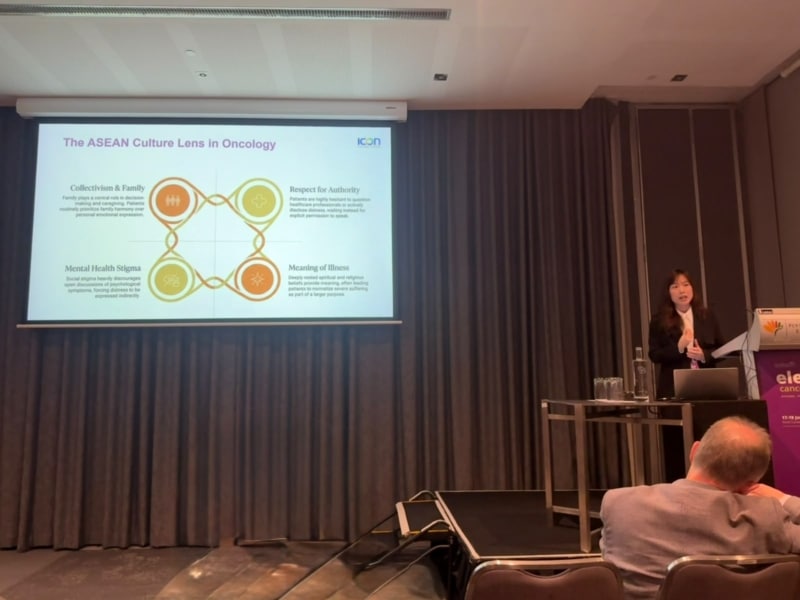
Pictured: Annie presenting at Cancer Nurses Society of Australia (CNSA) Congress 2026

Emotion does not follow a script

In ASEAN, psychological distress is filtered by culture. Decision-making is often collective, guided by family structures, social expectations, and respect for hierarchy. Patients may avoid voicing concerns to prevent burdening loved ones or appearing unappreciative.  

The standard diagnostic tools developed for western healthcare systems that adhere to an open and direct emotional discussion between carer and patient, are not sensitive to the spiritual, moral or existential lenses that frame emotional suffering in other cultures.  

For example, of the 31 distress assessments conducted with 22 patients as part of the ICC Singapore’s recent pilot program, 42% of patients recorded clinically significant distress scores but no patients provided an accompanying explanation when prompted.  

Instead, in many ASEAN settings, this distress presents indirectly through physical symptoms, hesitation, deference, non-verbal cues or concern for family rather than self. 

The risk of invisible distress

When cultural nuance is not accounted for, the distress amplifies, while also remaining invisible. 

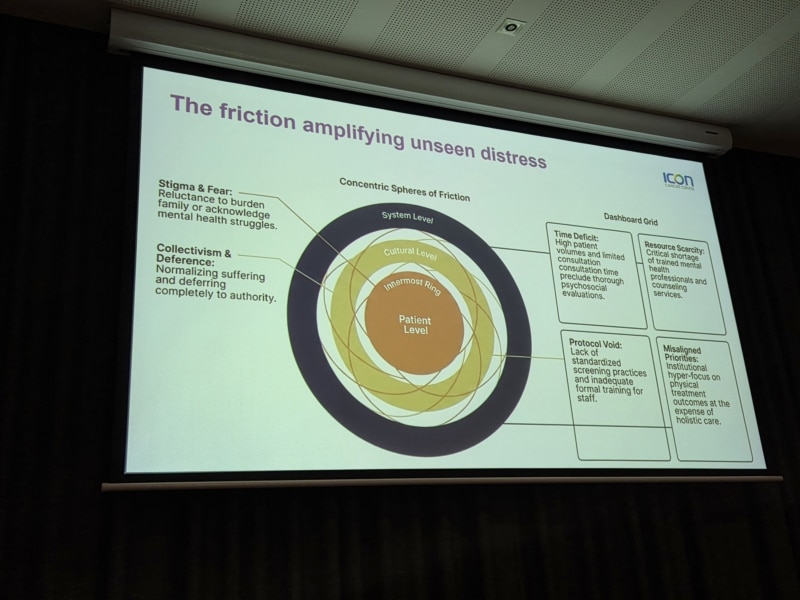
There are three layers of friction that reinforce this invisibility. The first is the patient and family level, where patients may normalise suffering or demonstrate reluctance in discussing emotional concerns with family due to stigma.

The second layer, revolving around cultural awarenessrecognises that clinical teams are often faced with time constraints or insufficient training in psychosocial assessment. Lastly, at a system level, workflows, protocol gaps and resource constraints can also reinforce this invisibility, particularly when limited time makes it difficult to recognise and respond to emotional needs. 

Pictured: Annie presenting at CNSA Congress 2026

The result is a measurement gap where patients are struggling with a system that has not evolved to accommodate the implicit emotion. Of the reported rates of emotional distress across ASEAN patients, the findings vary dramatically, not because the feeling differs, but because detection and psychoanalysis does. 

 The bridge between

Closing this gap requires organic human insight. Fortunately, this is where oncology nurses are uniquely positioned. 

Nurses spend sustained time with patients during their cancer treatment, observing what is said, and what is not. They notice subtle cues such as body language, family dynamics and repeated behaviours to which they learn to assign positive or negative receptions.  

Over time, nurses are able to interpret the patient’s culturally veiled distress, translating unspoken discomfort into meaningful clinical action.  

Nurses become the bridge between the patient’s internal emotion and a healthcare system that may otherwise move too quickly to detect it. This detection is paramount to delivering Icon’s patient-centred care model.

From screening to meaningful care: a new model

To move from awareness to impact, distress screening must be embedded into clinical workflows in a way that reflects cultural realities. 

To operationalise this, I have developed a four-step model as outlined below. 

  1. Routine patient screening using culturally adapted tools. Distress assessment should be as standard as monitoring patient pain or fatigue and conducted at various points throughout treatment. 
  2. Sensitive interpretation where assessment results are considered through a cultural lens, supported by open, indirect conversations that invite patients to share in a way that feels safe for them. 
  3. Escalation through multidisciplinary pathways. Distress should trigger coordinated support, including social work, counselling, spiritual care, and family engagement.  
  4. Consistent follow up because without continuity, the mediation may lose its impact. 

Screening without interpretation is incomplete; interpretation without escalation is ineffective; escalation without follow-up does not create continuity of care. 

Culture-driven care

Rather than importing models of care, healthcare providers across ASEAN must co-design approaches that reflect the cultural contexts of the patients we serve.  

This includes the practice of normalising conversations about emotional health by making them part of routine care, just like pain, nausea, or fatigue. This approach embeds psychological care into our everyday workflows. 

For Icon Group, this represents a strategic opportunity to lead the region in culturally intelligent cancer care and redefine how distress is recognised and managed across ASEAN leading to better patient outcomes. 

Caring for the whole person is critical to cancer care beginning with what too often has gone unseen. 
View all News

Search

Contact us